
Rock Tea White Paper · Rock Bone, Floral Aroma / CH.12
Buying Yancha
Zhengyan output is finite and prices are serious; outer-mountain tea posing as zhengyan is the norm of the market. Chapter Twelve of the Rock Tea White Paper: how to read the dry leaf, smell the aroma, taste the liquor — and avoid the pitfalls of buying.
The water of the yancha market runs deeper than the Nine-Bend Stream. Zhengyan output is finite, and outer-mountain tea posing as zhengyan is the norm. Learning to buy is the precondition of drinking yancha well.
1. The scarcity of zhengyan
Begin with one basic fact: zhengyan is scarce in the rigid sense.
Niulankeng Rougui yields only about 1,000 jin a year — a physical ceiling of the plot, not a dealer's hunger marketing. Zhengyan tea across the Wuyi subdistrict comes to about 700 tons a year (2021), roughly forty percent of that subdistrict's total yancha output. And Wuyishan City as a whole produced about 30,100 tons of dry rough tea in 2024 across 148,000 mu of gardens — zhengyan is a very small share of all Wuyi tea.
More important still: from 2008 Wuyishan imposed strict control on opening new tea land, and from 2013 banned the opening of new tea gardens outright. The area of zhengyan gardens cannot expand much — which means the supply of zhengyan will not grow while demand keeps rising. The scarcity is not a story. It is a fact locked in by policy and geography together.
- NiulankengRougui yields only about 1,000 jin a year — the physical ceiling of the plot.
- ShareZhengyan tea across the Wuyi subdistrict: about 700 tons a year, roughly forty percent of its yancha output (2021).
- PolicyStrict control on opening tea land from 2008; new tea gardens banned outright from 2013.
- Industry scaleIn 2024, Wuyishan City had 148,000 mu of tea gardens and about 30,100 tons of dry rough tea.
2. The outer mountains posing as zhengyan
Zhengyan is scarce; the outer mountains are abundant. That gap between supply and demand breeds the biggest pit in the yancha market: outer-mountain tea sold as zhengyan.
"Outer mountain" means tea districts outside the administrative area of Wuyishan City. Their soil is not Danxia gravel; their climate is not the ravine microclimate; their craft may fall short too. But outer-mountain leaf costs far less than zhengyan — and once it wears a "zhengyan" label, the profit multiplies. The Fujian provincial government's website has noted the practice of passing off non-core-region tea as zhengyan. This is not an occasional mischief; it is a structural problem of the market.
There is no simple test to separate outer mountain from zhengyan, but there is a general direction: zhengyan shows more distinct rock rhyme, a thicker liquor, an aroma that sits deeper; outer mountain shows weak rhyme, a thin liquor, an aroma that floats. Telling them apart takes many tastings and comparisons — tasting ability is the best anti-counterfeit label there is.
- The fraudHalf rock, zhou cha or outer-mountain tea passed off as zhengyan — the biggest pit of the yancha market.
- The differenceZhengyan: distinct rock rhyme, thick liquor, deep aroma. Outer mountain: weak rhyme, thin liquor, floating aroma.
- The rootZhengyan supply is rigidly finite; outer-mountain leaf is cheap and the profit large — the gap breeds the fraud.
What you taste is not the two characters of "zhengyan".
It is the plot behind them.
3. Reading the dry leaf and the spent leaf
To buy yancha, learn two basic skills: read the dry leaf, and read the spent leaf.
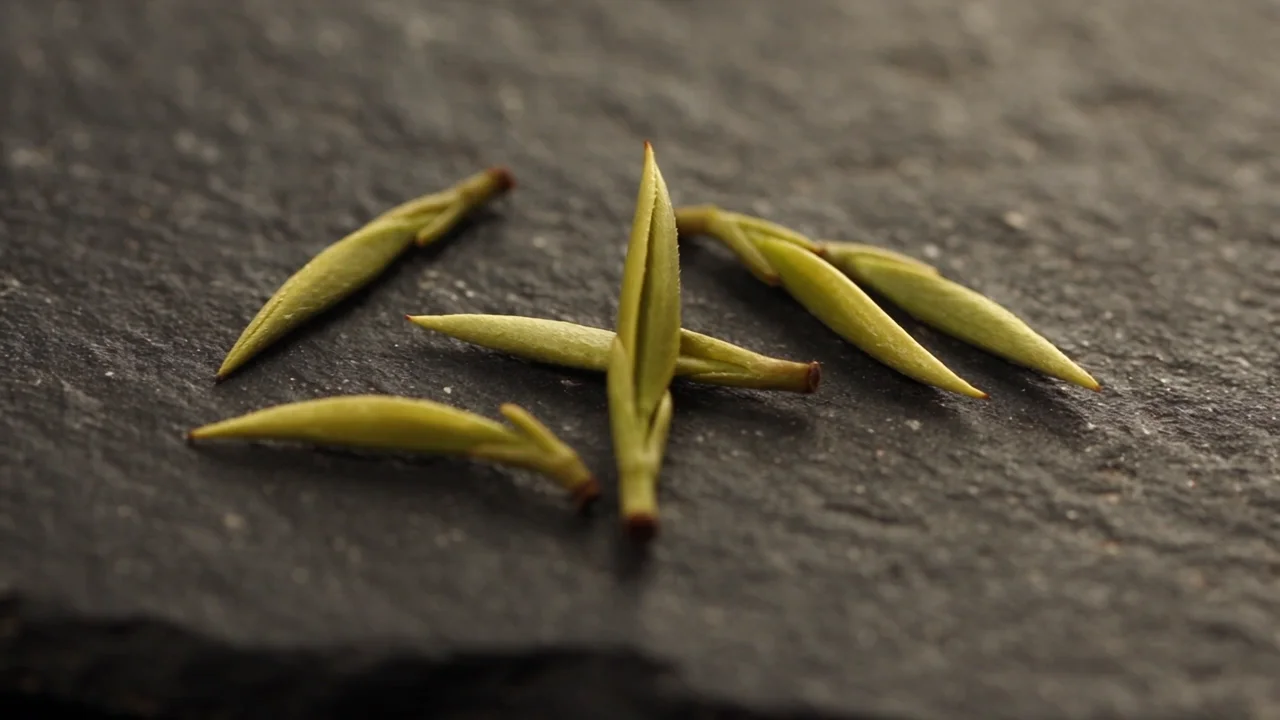
The dry leaf: true zhengyan comes in tight dragonfly-head strips, sandy green, oily, with a gem-like sheen. Loose strips, dull grey colour, much debris — the leaf was coarse, or the craft rough, or the keeping poor. Smell the dry leaf too: good yancha carries the compound scent of roast and cultivar, with no must, no mould, no sourness.
The spent leaf: after brewing it should show "green leaf, red rim" — edges bright vermilion, centre pale yellow-green or clear green. The leaf should be soft, glossy and springy. Spent leaf that is coarse and stiff, without the red rim, or a liquor that pours cloudy — doubt the craft or the leaf.
- Dry leafTight dragonfly-head strips, sandy green and oily with a gem-like sheen; the scent of roast and cultivar together.
- Spent leafGreen leaf with a red rim, soft, glossy and springy; coarse, rimless, dark leaf casts doubt.
- ColourOrange-yellow, clear and bright; cloudiness marks a flaw in craft.
4. The common sense of price bands
The price bands of yancha fall roughly into three tiers:
- Everyday drinkingOrdinary zhengyan and half rock form the mainstream of the market — fair prices, made for the daily cup.
- Advanced tastingCore ravine teas (Niulankeng Rougui among them) yield only about a thousand jin a year — serious prices, very little in circulation.
- Collector gradeFamous bushes, lao cong, special plots — the price follows scarcity and the state of storage.
Sky-high yancha comes mostly from scarce plots — "beef", "horse meat", old lao cong of Huiyuan: behind those names stands real scarcity. But a sky-high price is not for everyone. For the daily cup, choose medium-fire zhengyan — the best value; for advanced tasting, full-fire ravine tea — there you meet rock rhyme; for collecting, famous bushes and lao cong — there you pay for scarcity.
5. The bottom lines of buying
Finally, three bottom lines:
First, ask the plot before the price. Yancha with no known plot is not worth touching at any price — the plot is yancha's identity card, and a tea without an identity card has a doubtful identity.
Second, tasting ability is the best anti-counterfeit. Drink more, compare more, note more — your tongue is more reliable than any certificate.
Third, follow the tea, not the story. However legendary a tea's provenance, it ends in the cup. Tastes good is the only standard.
Buying covered — the final chapter returns to Mulan: how we make yancha.
TO TASTE · One cup from the same source
Collection advisory · private consultant
Buying yancha begins with understanding. Book a Mulan private consultant; settle the plot, the cultivar and the roast before the price.
Book a private consultant ↗THE WHITE PAPER OF ROCK TEA
The Rock Tea White Paper · Contents
Twelve chapters and an epilogue, taking yancha apart — plots, cultivars, craft and rock rhyme.