

Rock Tea White Paper · Rock Bone, Floral Aroma / CH.01
What Is Yancha
Yancha does not grow in cracks of stone; it grows inside a complete terroir — Danxia landforms, native cultivars and charcoal roasting, made into one oolong. Chapter One of the Rock Tea White Paper: the definition, the geographical indication, and the original meaning of rock rhyme.
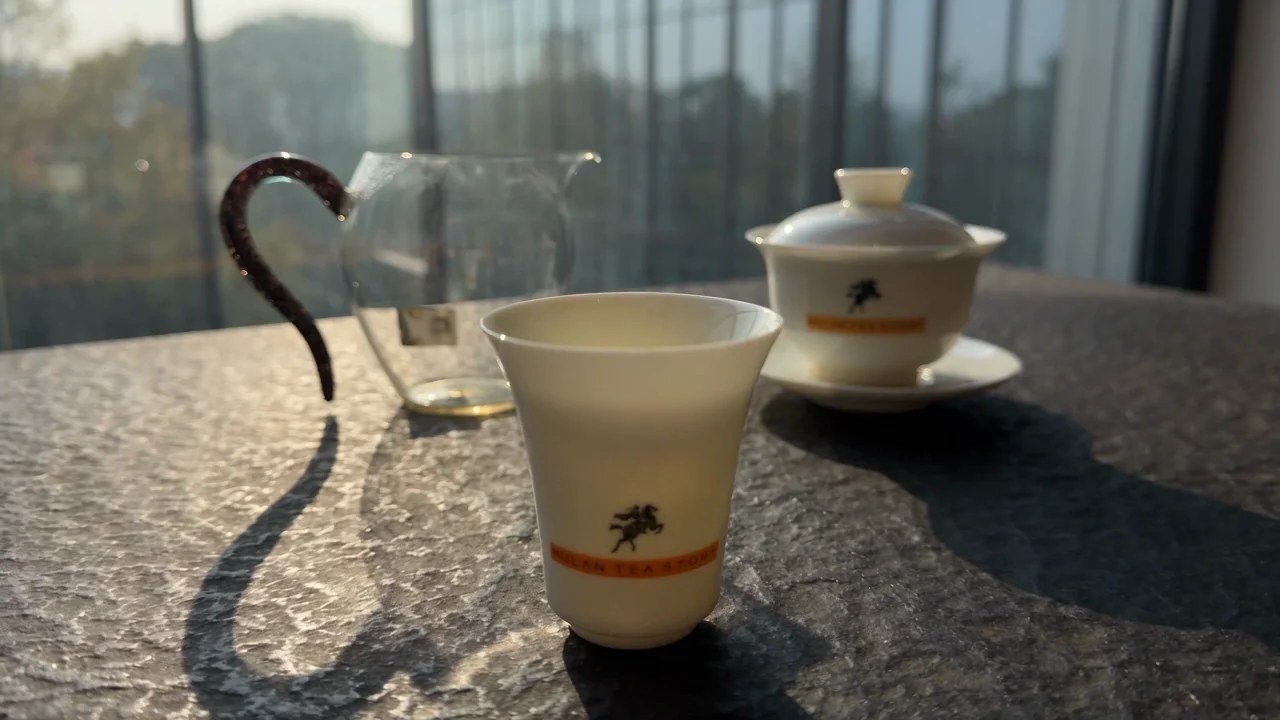
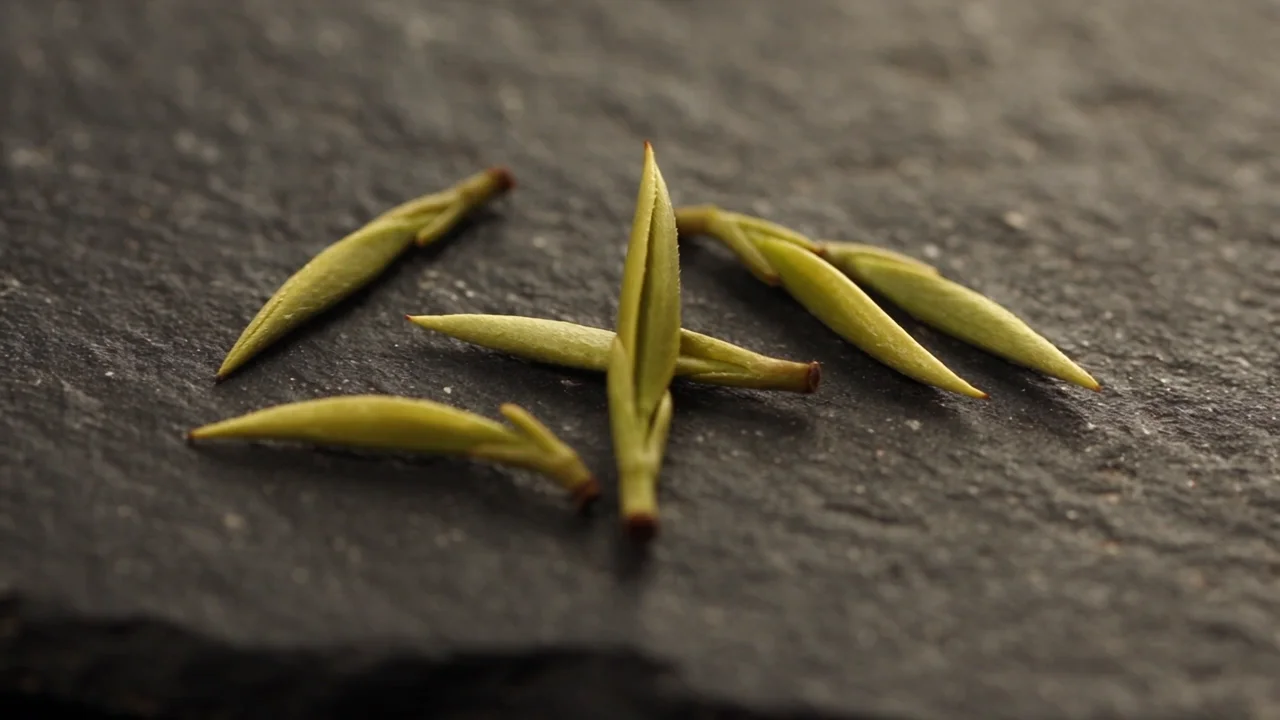
Yancha is not tea growing on stone. It is tea growing inside one complete terroir: Danxia rock for bone, gravel soil for flesh, cloud for clothing, charcoal fire for soul.
1. The legal boundary
Before talking about yancha, draw the boundary. The current national standard, GB/T 18745, "Geographical Indication Product — Wuyi Rock Tea", states it plainly: the protected area of Wuyi rock tea is limited to the administrative area of Wuyishan City, Fujian Province. Outside that boundary, even with the same cultivar and the same craft, the tea may not be called Wuyi rock tea.
This is what a geographical indication means — it binds the tea to a specific land by law. The roughly seventy square kilometres of the Wuyishan scenic area form the core, where the Danxia landform has reached maturity. Its weathered rock and gravel soil is loose, well-aerated and rich in minerals. Lu Yu wrote in The Classic of Tea that "the finest tea grows on crumbled rock, the middling on gravel soil" — and most Wuyishan tea gardens stand exactly on such ground.
- National standardGB/T 18745-2006 "Geographical Indication Product — Wuyi Rock Tea" limits the protected area to the administrative territory of Wuyishan City; a new edition, GB/T 18745-2026, has been issued and takes effect on 1 April 2027.
- LandformA mature Danxia landscape; weathered rock-gravel soil, loose, aerated and mineral-rich — the "crumbled rock" of The Classic of Tea.
- ClassificationThe national standard divides Wuyi rock tea into five classes: Da Hong Pao, famous bushes (mingcong), Rougui, Shui Xian, and qizhong.
2. The northern branch of oolong
Yancha belongs to oolong — qingcha, the semi-oxidised tea. Chinese oolong has four schools: northern Fujian, southern Fujian, Guangdong and Taiwan. Wuyi rock tea is the representative of northern Fujian oolong, and the craft's source: in the early Qing dynasty, the bruising craft of oolong — zuoqing — was invented at Wuyishan, and only then spread south to southern Fujian and east to Taiwan.
Among the four schools, yancha has the fiercest character. Tieguanyin seeks clarity, Dan Cong seeks aroma, Taiwan oolong seeks softness — yancha seeks "bone": a structural sense held up by the minerals of the plot and the fire of charcoal roasting. A good yancha has weight in the liquor, a landing place for its aroma; swallow it, and something echoes at the base of the throat.
3. Where "rock bone, floral aroma" comes from
These four words — rock bone, floral aroma — are the shortest summary of yancha's soul. Their documented origin is later than many assume: not Tang poetry but the Republican era. Lin Fuquan, in his 1943 study of Wuyi tea production and trade, wrote that Wuyi tea "gathers the finest spirit of mountain and stream, and its taste possesses the distinction of rock bone and floral aroma". Lin Fuquan was a tea specialist who worked deep in the Wuyi mountains during the Republican period; his records rest on field investigation and can be trusted.
An earlier clue lies with the Qianlong Emperor. His poem "Boiling Tea on a Winter Night" contains the line "Among them all, Wuyi is the finest taste — clear and gentle in flavour, yet with bones in it". Tea scholars generally take this "bone" as the earliest form of "rock bone". An emperor, sitting by the fire on a winter night, tasting bones in Wuyi tea — likely the first royal footnote to rock rhyme.
- Rock bone, floral aromaFirst documented in the Republican era, in Lin Fuquan's 1943 study of Wuyi tea: "its taste possesses the distinction of rock bone and floral aroma".
- Earliest form of the boneQianlong Emperor, "Boiling Tea on a Winter Night": "Among them all, Wuyi is the finest taste — clear and gentle in flavour, yet with bones in it".
- Even earlierThe Ming writer Wu Shi, in his Miscellany of Wuyi, judged Wuyi tea as "carrying cloud and stone, with a sweet, soft breath beneath".
The rock bone is given by the mountain.
The floral aroma is kept by the fire.
4. The threshold of rock rhyme
Rock rhyme is yancha's passport, and its watershed. In the sensory vocabulary of the national standard, famous bushes are required to show "distinct rock rhyme" — one of the few flavour descriptions written into a national standard.
What is rock rhyme? Liang Zhangju, in his Notes from Retirement, built a four-step ladder: fragrance, clarity, sweetness, liveliness. Fragrance is the base; clarity the next step — fragrant but not clear, still an ordinary tea. Sweetness climbs again — clear but not sweet, merely a bitter brew. Last comes liveliness — sweet but not lively, only a good tea. Liveliness is the hardest word. Liang Zhangju said it himself: "it must be discerned with the tongue's root — subtle beyond subtlety". The far end of rock rhyme is this word: the liquor is alive in the mouth, and after swallowing, the sweetness and salivation keep moving.
That liveliness comes from the meeting of plot and craft. The cloud of the ravines, the minerals of the gravel soil, the weight of the bruising, the timing of the charcoal — remove any one, and the word cannot stand.
5. Why a whole book for one tea
Yancha is among the most misunderstood categories in Chinese tea. It has been mythologised — sky-high priced "beef", the legend of the mother trees. It has been muddied — outer-mountain tea sold as zhengyan, heavy fire masking rough leaf. Both come from the same cause: too many people talk about yancha, too few explain it through.
This white paper does one thing: take yancha apart, through to the end. From the geology of the plots to the map of cultivars; from the fire of the craft to the vocabulary of tasting; from a thousand years of history to today's buying decisions. Twelve chapters and an epilogue, all grounded in national standards, local gazetteers and academic research. After reading it you may not become an expert — but you will see through most of the sales talk.
The gate of yancha opens with the next chapter — first, up the mountain, to see the plots.
TO TASTE · One cup from the same source
The Mulan signature · Jiulongke Da Hong Pao
Jiulongke is the ravine where the mother-tree Da Hong Pao has lived for generations — deep rock walls, cloud that never lifts. Named after the gorge, the name explains its own origin.
See the Mulan signature ↗THE WHITE PAPER OF ROCK TEA
The Rock Tea White Paper · Contents
Twelve chapters and an epilogue, taking yancha apart — plots, cultivars, craft and rock rhyme.