
Rock Tea White Paper · Rock Bone, Floral Aroma / CH.04
The Truth of Da Hong Pao
The six mother trees on the Jiulongke cliff stopped being picked in 2006; Da Hong Pao on the market is either pure cultivar or blend. Chapter Four of the Rock Tea White Paper: the name, the bloodline and the logic of the commodity.
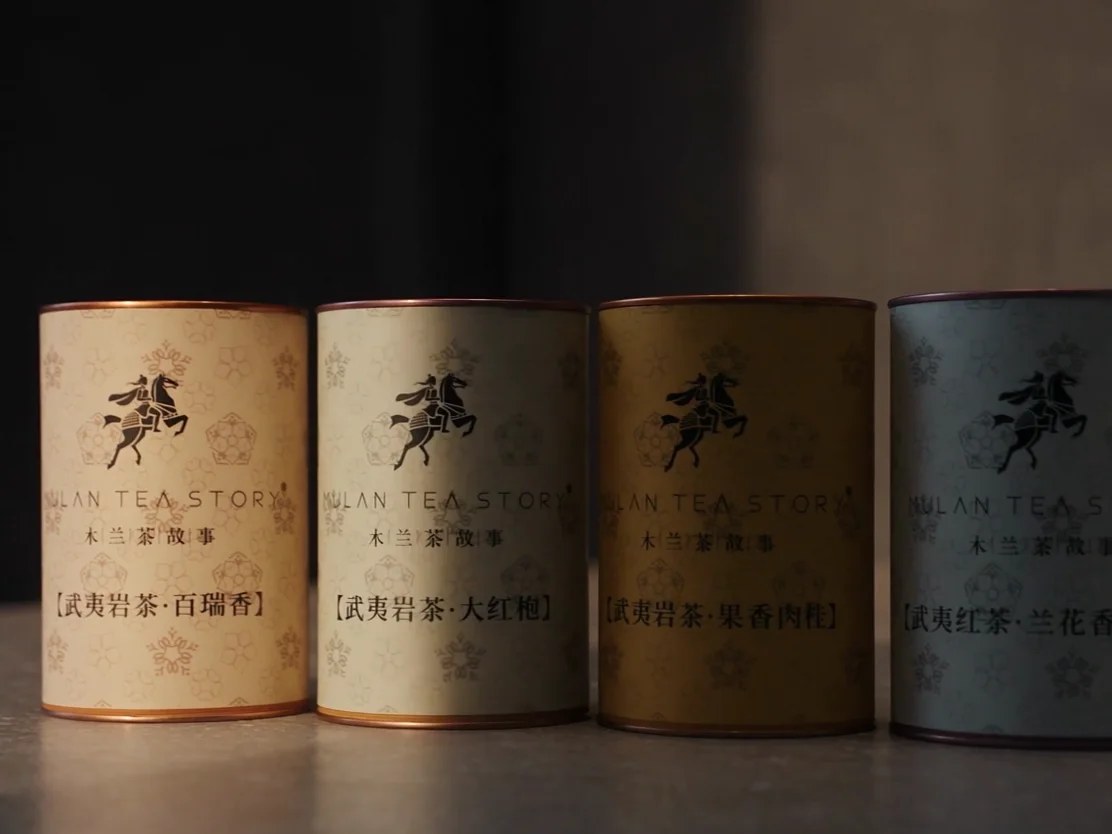
Da Hong Pao is the loudest name in the world of yancha — and the most misunderstood. The truth has three layers: mother trees, pure cultivars, blends. Each layer is different.
1. The mother trees of Jiulongke
The mother-tree Da Hong Pao grows on the high cliffs of Jiulongke in Wuyishan — six trees remain (two of them grown by asexual propagation), about three hundred and fifty years old. These are not garden tea. They are cliff tea — rooted in rock crevices, fed by spring water and cloud, and unmoved for over three centuries.
Long ago the six mother trees stopped being production material and became heritage. In 2003, the Wuyishan city government insured them with the People's Insurance Company of China under a product liability policy worth one hundred million yuan. From May 2006 they passed into special care: harvesting stopped for good, and technicians prune them each year and keep detailed records. The final twenty grams picked and made in 2005 entered the National Museum of China in 2007.
- LocationHigh cliffs of Jiulongke, Wuyishan; six trees remain (two grown by asexual propagation), about 350 years old.
- InsuranceIn 2003 the Wuyishan city government insured the six mother trees with a 100-million-yuan product liability policy.
- Harvest stoppedFrom May 2006, special protection with no picking; yearly pruning and detailed care records.
- MuseumThe last 20 g of 2005 entered the National Museum of China in 2007.
Even the count is not settled in the record. In 1943 Lin Fuquan's study of Wuyi tea production and trade noted only two clusters. Six is the modern tally, and the two trees of asexual origin explain the gap. Perhaps the truth is this: the "original" mother trees were always very few, and the six we see today are what asexual propagation left standing.
2. Pure cultivars: Qidan and Beidou
The mother trees stopped yielding, but the genes remained. Through scientific asexual propagation, three lines confirmed as descendants of the mother trees carry the name forward: Qidan, Beidou No.1 and Beidou No.2. Of these, Qidan is held to come closest to "the pure Da Hong Pao in the biological sense".
The name Qidan comes from Song dynasty praise of Wuyi tea — an old name for tea itself. It inherits the mother trees' character: an aroma rich with bone, a full body, a returning sweetness. But even a pure cultivar, planted on different plots and roasted by different hands, will differ in style. The bloodline is guaranteed; the replication of the mother trees is not.
- QidanConfirmed by asexual propagation as a descendant of the mother trees; held to be "the pure Da Hong Pao in the biological sense".
- BeidouBeidou No.1 and No.2, lines of mother-tree descent confirmed the same way.
- LimitsBloodline is guaranteed; plot and craft still decide the final style.
3. Blends: the wisdom of commodity Da Hong Pao
Almost all the Da Hong Pao on the market is blended Da Hong Pao. That is not a trick; it is a science.
In the 1980s, the Wuyishan tea research institutes took their cue from the natural blend growing on the cliff — and in the early 1990s researchers confirmed that the six mother trees are themselves a blend of different cultivars. If nature could compose a legend on the rock face of Jiulongke, why should the logic not continue inside a tea factory?
So commodity Da Hong Pao, blended from several lines, was born. The earliest version released to the public came from the Tea Science Institute under the Tea Bureau — 15 grams to a box, priced at $11.99. The logic of blending is simple: take strengths, cover gaps. Rougui lifts the aroma; Shui Xian adds body; qizhong lays the base; new cultivars brighten the top. A good blended Da Hong Pao is nobody's stand-in — it is an independent, complete work.
- PrincipleConfirmed in the early 1990s: the six mother trees are themselves a blend of different cultivars.
- StartIn the 1980s, the Wuyishan tea research institutes began developing a blended commodity Da Hong Pao.
- First releaseThe first blended Da Hong Pao sold publicly came from the Tea Science Institute under the Tea Bureau — 15 g a box at $11.99.
The mother trees are a legend that cannot be copied.
Blending is a wisdom that can be passed on.
4. Three layers of truth
Facing a Da Hong Pao today, first place it in its layer:
- Mother-tree Da Hong PaoSix trees on the Jiulongke cliff; picking stopped in 2006; the last 20 g of 2005 is in the National Museum of China. It does not exist on the market.
- Pure-cultivar Da Hong PaoQidan, Beidou and other asexual descendants; limited output, serious prices.
- Commodity Da Hong PaoA blend of several lines; the vast majority of the market; quality depends on the blender.
Between the three layers there is no rank — only different positions. The mother trees are heritage; the pure cultivars are bloodline; the blends are the everyday. A mature yancha market needs all three at once — just as a mature wine market needs both a Romanée-Conti and an honest table wine.
5. The weight of a name
The name Da Hong Pao carries too much legend: the red robe draped in gratitude by a returning scholar, three hundred and fifty years of wind on the cliff face, twenty grams kept in the national museum. These stories give the name a weight beyond the tea itself.
But the heavier the name, the more the truth must hold it up. Telling mother trees, pure cultivars and blends apart is not a way of looking down on blends. It is a way of giving each layer its own place — the mother trees protected, the pure cultivars treasured, the blends taken seriously.
Next chapter, we leave cultivars and legend behind and enter the real core competitiveness of yancha — the craft.
TO TASTE · One cup from the same source
The Mulan signature · Jiulongke Da Hong Pao
Named after the gorge, the origin of the name told in full. One work, speaking for the house.
See the Mulan signature ↗THE WHITE PAPER OF ROCK TEA
The Rock Tea White Paper · Contents
Twelve chapters and an epilogue, taking yancha apart — plots, cultivars, craft and rock rhyme.