
PARTNERSHIP MEMORANDUM · City Partner
An International Super-Symbol · The Mulan IPThe light-luxury tea cuisine of MULAN TEA STORY — MULAN DIAN®The first tea brand built around the tea egg
A tea egg simmered for two hours with whole-leaf Da Hong Pao — it is cheap, it is frequent, it needs no explaining; that is the whole case for making it the signature. In a braised-food category worth RMB 157.3 billion, 85.6% of brands run fewer than fifty stores; China deep-processes only 5%—7% of its eggs, Japan 50%. An owned central kitchen, two heritage lineages and 16 million members make this one egg replicable — and priceable.
THE FILM · Four Shorts
Four shorts · two minutes
to understand one store
One egg, the Four Classics, the system, the partnership — thirty seconds each. Watched in order, that is the whole structure of the business.
CONTENTS · Ten Chapters
The ten chapters below follow the order of an investment memorandum: opportunity, timing, moat, system, store formats, the ledger, pricing, partnership, risk, next steps. Every figure is checkable — the basis and source sit behind each "!" mark.
BEFORE YOU SIGN · Four Questions
Four things
answered in person
How much in, how long to return, what HQ runs, what if it loses — until these four are answered, no signature is worth signing.
I
How much in
CAPITAL
Four tiers by city and format: flagship, large store, small store, egg cabinet. The lead seller is one egg — the lightest goods structure of the Four Classics: less stock, faster turns, a clear waste ledger. HQ holds the majority of every store; equipment arrives on monthly terms, so cash is never sunk in machines upfront. A written investment list is issued at the meeting.
II
How long to return
RETURN
Public industry data: mass-market dining 12 — 24 months; the dumpling trade, rent and labour included, about 20 — 30 months (Chapter 6; not this brand's stores). We do not promise your payback period — we run it on your city's real rent, labour and footfall, and hand you the written model.
III
What HQ runs
SUPPORT
Six things, all covered: IP traffic, equipment on monthly terms, supply-chain finance, cold chain, the 5A system, store management. How to open, how to shelve, how to roster — handbooks and on-site coaching.
IV
What if it loses
DOWNSIDE
Four kinds of risk and their handling sit in Chapter 9. Who this does not suit is written there too — those who only want to hang a sign, or expect payback in three months: we do not sign them.
01 / OPPORTUNITY · The Gap
The gap
one egg cuts open
The tea egg is not a new category — it is a category made for a hundred years and never made. It has always hung in paper bags at breakfast stalls: no brand, no provenance, never counted as its own revenue line in any store model. We made it the doorway into a business: one egg draws the crowd, the Four Classics carry the ticket, the bag brings the repeat, equipment and cold chain carry the copy. The first tea brand built around the tea egg — that is the claim.
I
The recognition gap
One egg needs no market education — it is the most familiar mouthful in a Chinese household, recognised at every age. Tea dumplings need explaining; the tea egg does not. It also arrives with five directions: classic Da Hong Pao, five-spice Pu'er, mala rock rhyme, osmanthus black tea, Miaoling sweet tea — one base, five characters, and a store's product width is there. Every point of recognition cost saved is money left for the site and the stock.
II
The supply gap
Egg processing still sits at 5%—7%. On the shelf, eggs are still sold loose, boiled at the morning market, their flavour left to a master's one pot of brine. We made it a product that can be standardised: whole-leaf Da Hong Pao in the pot, never tea dust; three things withheld — no artificial flavouring, no colouring, no tea dust. The ingredient list: eggs, tea, water.
III
The site gap
Last year nearly 30,000 bubble-tea stores closed net, a second straight year of net decline, leaving sites with fit-out, footfall and leases in hand; the Top-100 convenience chains run 208,000 stores with nearly a hundred fresh-food SKUs — what they lack is "a lead seller that can hold the morning peak". That spot was always waiting for an egg.
THE ENGINE · The Signature Model
One egg
how it feeds a store
The signature is not "the item that sells most" — it is "the item that sets the whole store turning". The egg calls people to the door; the Four Classics lift the ticket; the bag turns one visit into a week of repeats; equipment and standards carry the whole thing to the next city. Connect the four, and a business stands.
I · TRAFFIC
Traffic · one egg
Low ticket, high frequency, no explaining needed. It stands at the door and takes in the morning peak's first cash — the hardest thing for a store is "someone walks in"; this egg answers exactly that.
II · MARGIN
Margin · the Four Classics & the tea table
Once inside, dumplings, tangyuan, zongzi and the tea table carry the lunch hour and the night. The egg brings people in; the Four Classics keep the ticket — eggs alone cannot carry the rent; the Four Classics alone cannot open the door.
III · REPEAT
Repeat · six to a bag
Ready from the bag, best warm, five more minutes of steam for a deeper aroma. It turns "one visit" into "a week at home" — repeat does not rely on another trip into town; it relies on a bag in the fridge.
IV · COPY
The copy · equipment & standards
The fire is written into the machine, the recipe into the central kitchen, the cold chain runs to the freezer. One pot of flavour — whoever opens it, in whatever city, the same flavour. Only what can be copied earns the word "chain".
The egg in convenience stores · a ledger already proved
One egg's price and volume
- Convenience store daily revenue per storeRMB 4,453 · 2025
- Convenience-store tea egg priceRMB 2.5 / egg
- Breakfast-stall tea egg priceRMB 2 / egg
- Suguo daily sales (selected stores)150 eggs
- Taiwan, China 7-ELEVEN annual sales100m+ eggs · about 40% gross margin
Convenience stores long ago made the egg a standard item: two yuan apiece, sold by seven in the morning. That answers a simpler, harder question — does an egg move at the morning peak? It moves. But a convenience store can only make it a filler SKU on a shelf; what we are making is a store's lead seller.
Basis note Braised-food category size and store concentration: Hongcan Industry Research Institute / Hongcan Big Data, Braised Food Category Development Report 2025; egg-processing market, liquid egg and egg-powder output: Guanyan Tianxia Data Center (a commercial research firm's basis, not an official statistic); poultry egg output: NBS, 2024 Statistical Communiqué on National Economic and Social Development, with chicken eggs at about 85% of poultry eggs per the 2025 China Layer Industry Development Trends Report citing NBS; global braised-egg market: QYResearch, third-party global basis; convenience-store daily revenue per store: KPMG × CCFA, 2026 China Convenience Store Development Report; convenience-store and breakfast-stall tea egg prices: Jimu News field visits, 2026; Suguo single-store daily sales: Xinhua Daily and China.com.cn finance reporting, 2018 — selected stores, single-day basis, not an industry average; Taiwan, China 7-ELEVEN annual sales and gross margin: Huxiu, 2019 — Taiwan, China basis, not mainland-market data. These figures belong to different institutions and statistical scopes and are used only to describe industry background and trends — not summed, converted or extrapolated.
02 / TIMING · Why Now
Six things
aligned at once
Whether a field is worth entering is not about how loud it is — it is about how many conditions hold true at the same time.
I · POLICY
Policy
Outside the pre-made-dish scope
Egg products and ready-to-eat tea food sit outside the pre-made-dish regulatory scope; the 15th Five-Year Plan backs origin cold chains and farm-product processing — a policy boundary, not a policy risk.
II · COLD CHAIN
Cold chain
Refrigerated trucks +30.2%
Warehouse capacity and fleet are expanding together. The egg is a short-shelf product — the cold chain is not a bonus but the precondition: it decides whether an egg can cross cities and land in a cabinet still right.
III · COUNTER
Breakfast & convenience fresh food
Away-from-home breakfast RMB 700 — 800 bn
The egg's golden hours are the morning peak. A convenience store takes RMB 4,453 a day with nearly 100 hot-food SKUs — what they lack is not traffic; it is a proper egg.
IV · NIGHT
Night
RMB 36.4 trillion
Tea with a bite was always a "sit down" business — the night needs a table more than the day does.
V · PEOPLE
People
Single-person households 25.4%
Eating alone, still willing to pay for a proper meal — dignity for one is the layer where tea food is worth more than bubble tea.
VI · CULTURE
Culture
RMB 179.85 bn · +15.9%
Goods with a provenance are already being priced on their own — heritage and an Eastern IP are no longer a bonus; they are part of the price.
03 / MOAT · What Can't Be Copied
Four things
you cannot buy elsewhere
A product can be copied; supply can be undercut. Owned capacity, heritage provenance and a crowd that already knows you cannot be.
I
The industry
FACTORY · EQUIPMENT
A 300,000-hen farm estate in Shayang, Jingmen, Hubei, 270,000+ fresh eggs a day — the egg's source sits in our own system, not at the wholesale market. Antibiotic-free across the full cycle, zero drug residue, feed-additive technology certified safe by the US FDA. One owned central kitchen sets the output; in-house equipment writes the fire into the machine; a national cold chain runs straight to the store freezer. Only those who can ship their own eggs get to set the standard for others.
II
IP
INTELLECTUAL PROPERTY
The Mulan legend is national-level heritage; shadow play is a heritage of humanity. Add the MULAN XU® emotional engine and the galloping-horse mark — provenance written into the product is what holds a premium up.
III
People
MEMBER POOL
16 million members in the parent brand's system. Opening day is not a cold start — it is inviting in people who already know us.
IV
Channels
STORE MATRIX
Four formats — flagship, large store, small store, display cabinet — mixed by site within one city: image, experience, efficiency, density, each with its own job.
This egg
why no one else can make it
One egg is not hard to make. What is hard is making every one the same. Three thresholds lift the cost — and pull the difference apart.
I
Whole leaves, never dust
Whole-leaf Da Hong Pao in the pot, never tea dust. Five flavours share one base, tea and egg simmered together — dust clouds the taste, whole leaves keep it clean; if that layer of aroma is not fixed, the flavour falls apart. The ingredient list has three things: eggs, tea, water.
II
Safe-to-eat-raw egg standard
300,000 hens of our own, antibiotic-free across the full cycle, zero drug residue, salmonella suppressed. Feed carries Korean SEM-BIO natural-mineral technology (potassium, magnesium, iron), certified safe by the US FDA; eggs are collected to the safe-to-eat-raw standard — graded, washed, candled, retained as samples, chilled at 0—8℃ straight through with no handovers.
III
Slow simmer & cold chain
A hard fire boils the egg, a slow fire simmers the flavour; the two hours are handed to the machine's presets — every batch, one pot of taste. Simmered, sealed fresh, into the cold store, cold chain all the way to the store freezer: one taste, everywhere. Short shelf life is not impossible — it is just impossible without the cold chain.
IP is not decoration
it is the layer that prices
I
Two heritage lineages
The Mulan legend is national-level heritage (jointly inscribed by Huangpi, Hubei and Yucheng, Henan); shadow play is a heritage of humanity. Neither provenance is a licence sticker — both are public registers that can be verified; MULAN DIAN® draws on the subject matter and reinterprets it, and is not the protecting institution or a representative inheritor of either project.
II
Interactive
MULAN XU® finds your Benming tea food in five questions, turning one purchase into a story worth telling. A story that can be told is what holds the ticket up.
III
Extensible
Licensed-merchandise retail reached RMB 179.85 bn, +15.9% year on year — goods with provenance are already priced on their own. Regional public brands carry an average premium of 33% — write the provenance into the name, and the price climbs.
04 / SYSTEM · Six Supports
Six things a store needs to live
HQ covers them all
The most common death in the chain business is not a product no one can make — it is the five things beyond the product that no one runs: traffic, money, equipment, goods, systems, people.
I / TRAFFIC
IP traffic
A 16-million member pool in the parent brand, MULAN XU® review interactions, shared offline gatherings and tea tables. Opening day is not a cold start.
MEMBER POOL → STORE TRAFFIC
II / EQUIPMENT
Equipment on monthly terms
Egg-boiling units, the intelligent fire equipment, steamers and cold-chain cabinets arrive on monthly terms — cash is not sunk into machines; cash stays with operations.
MONTHLY · NOT LUMP SUM
III / FINANCE
Supply-chain finance
Credit terms and turnover support for goods: peak-season stock does not demand all your cash; payment terms on the supply side are carried by HQ together with financial institutions.
CREDIT · CASH FLOW
IV / COLD CHAIN
Cold-chain service
Central-kitchen output, national cold-chain dispatch, temperature held the whole way. The egg is short-shelf — from pot to store cabinet every minute is a countdown. The store needs only a freezer; no central kitchen, no local prep room.
CENTRAL KITCHEN → FREEZER
V / 5A SYSTEM
The 5A internal system
Ordering, stock, waste, rostering, members, reconciliation — one system through. Eggs stocked to the hour, near-expiry alerts automatic, waste on the record. Data lives online; the books do not lean on memory.
ONE SYSTEM · ALL STORES
VI / OPERATIONS
Store management system
One SOP, training, supervision, inspection. How to open, how to roster, how to shelve — handbooks and on-site coaching.
SOP · TRAINING · AUDIT
Note Written plans, limits and rates for equipment financing and supply-chain finance are quoted per city and format at the meeting; this page describes the system only and is not a financial commitment or any guarantee of returns.
05 / STORE MATRIX · Four Formats
Four store formats
choose one by city and site
One blueprint is not copied into every city — the flagship sets the image, the large store the experience, the small store the efficiency, the egg cabinet the density. In all four formats the lead seller is the same egg; only its role changes: the flagship's set order, the large store's morning, the small store's all day, the cabinet's density. Two ways in: wholly owned direct operation, or a controlling partnership with HQ holding the majority — one brand, one taste, one supply chain, one equipment set, one image.
Flagship
FLAGSHIP · Wholly Owned- Mode
- Wholly owned, operated and led by HQ
- Format
- Tea house + the full Four Classics + MULAN XU® theatre interaction + national-heritage shadow-play display
- Lead seller
- The tea table and the Four Classics; the egg sets the order and closes every seating
- Role
- The city's brand window and training base
- Fits
- Core shopping districts of provincial capitals and key cities
Large store
LARGE STORE · Controlling Partnership- Mode
- Controlling partnership; HQ holds the majority and posts supervisors
- Format
- Tea house + tea light meals — eggs in the morning, tea light meals at noon
- Lead seller
- Eggs to go in the morning + the Four Classics at the table at noon — two peaks a day
- Role
- Carries the tea-drink store's upgrade further, turning drink customers into table customers
- Fits
- City-district centres, mature neighbourhood high streets
Small store
SMALL STORE · Controlling Partnership- Mode
- Controlling partnership; HQ holds the majority, operations standardised
- Format
- Takeaway egg counter: freshly boiled tea eggs lead, with tea and the Four Classics to go
- Lead seller
- The egg — small floor, high frequency, run by one person
- Role
- The lightest version of the single-store model — prove it, then scale it
- Fits
- Office-tower ground floors, school and neighbourhood entrances
Egg cabinet
SMART CABINET · Site Partnership- Mode
- Equipment placed and held by HQ; the site holder is the venue partner
- Format
- Self-serve egg cabinet + boiling equipment; eggs and the Four Classics sold retail to go
- Lead seller
- The egg — restocked by the hour, labour and rent minimised
- Role
- Spreads the brand where a store cannot stand — density and visibility
- Fits
- Transport hubs, mall atriums, campuses and hospitals
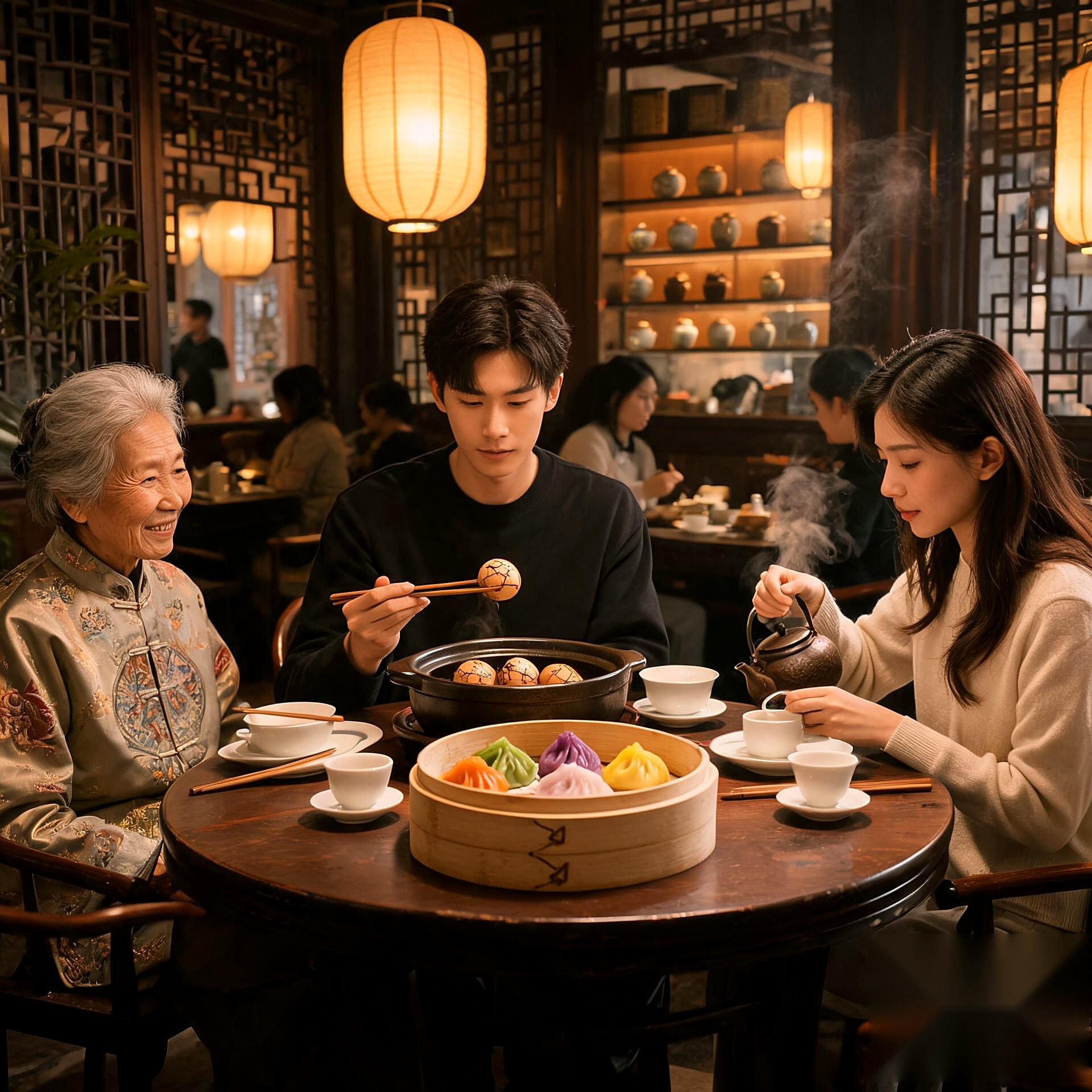
A store need not be big — it needs people willing to sit down. One hot pot, one table, one proper meal.
06 / UNIT ECONOMICS · The Ledger
The ledger
how to count it so it holds
We will not try to persuade you in one line. Below is one store's revenue structure and cost structure — structure holds up better than numbers.
Revenue structure
- Egg · at the table, boiled to goTraffic · high frequency
- Egg · retail bag to take homeSteady · low friction
- The Four Classics at the table (dumplings / tangyuan / zongzi)Margin
- Tea tables and IP eventsPremium
- Egg cabinets and self-serve unitsSupplement · density
Five fixed dayparts: the morning peak rides on the egg, lunch on the table, the afternoon on tea and retail bags, the night on events and tea tables. The egg's meaning is not volume — it is that it opens the door every single day.
Cost structure · industry ranges
- Food cost30% — 45%
- Labour cost20% — 30%
- Rent & property10% — 20%
- Marketing & online8% — 20%
- Three rigid costs combinedbest kept under 70%
The industry white-paper reading: food about 40%, labour about 25%, rent about 20%, marketing about 8%. Once the three rigid costs pass 70%, what is left no longer covers traffic and tax.
Payback period · industry references
- Mass-market dining (CCFA basis)12 — 24 months
- Tea drinks10 — 18 months
- Full-service dining18 — 36 months
- County-level chain dining (2025)24 — 30 months
- Dumpling-trade leaders · rent & labour included20 — 30 months
Industry rule of thumb: 8—12 months is healthy, 12—18 a normal climb, past 24 is endurance. Find your band first; then talk about opening.
The egg's ledger
how to count it without loss
The signature's model is simpler than the Four Classics' — and stricter: it runs by the hour, so waste must be counted by the hour. Pricing does not chase the convenience store: RMB 2.5 apiece there is shelf-filler logic; our egg steeps two hours in whole leaves with a named provenance — priced by value, not as filler. The four rules below are written into the partnership agreement; nothing is left to after-the-fact explanation.
| Item | How it works | Basis |
|---|---|---|
| Stocking | Orders placed by format and daypart; eggs go straight into the cabinet on arrival, selling by the hour | A short-shelf item, delivered in batches per store — never one giant push |
| Waste | Unsold eggs are logged daily at store level; who owns the loss is written into the partnership agreement | Actual store waste records govern — never back-calculated from totals |
| Near expiry | The system alerts by batch; transfer first, or convert to retail packs | Batches traceable, first in first out |
| Dayparts | Morning-peak stock runs above noon, corrected weekly against each store's sales | Rolling adjustments by the week — no one-time quarterly order |
| Same-trade reference | Upfront investment | Daily GMV per store | Avg ticket | Payback basis |
|---|---|---|---|---|
| Yuanji Yunjiao raw-and-cooked economy store |
≈ RMB 300,600 rent & labour excluded |
RMB 4,158 — 4,688 | ≈ RMB 22.5 | 13 months at the company's own fastest; with rent, labour, platform fees and HQ levies included, industry estimates run 20 — 30 months |
| Grandpa Xiong 35㎡ fresh-wrap store |
Fit-out ≈ RMB 20,000 (RMB 500/㎡) equipment ≈ RMB 60,000 · first stock ≈ RMB 60,000 |
Not disclosed | Not disclosed | Not disclosed |
| Yuanxiao Jiao raw / raw + dine-in |
RMB 103,000 — 178,000 three tiers by format |
Not disclosed | Not disclosed | 8.2 — 10.3 months by the brand's own account |
Basis note Yuanji: HKEX prospectus filings and public reporting; Grandpa Xiong and Yuanxiao Jiao: the brands' own public materials; cost structures and payback periods: Xinhuanet's 2025 China Restaurant Industry Ecosystem White Paper and the 2026 Report on Restaurant Cost Reduction and Efficiency Strategies; category bases: CCFA. All of the above are public same-trade figures — not the operating data of MULAN DIAN® stores.
07 / CAPITAL VALUE · Pricing
How the market
prices this business
Food retail is rarely told as a capital story — it is a cash-flow business first. But once it grows three things, brand, industry and channel, the way it is priced changes.
Flagships and large stores set the benchmark; small stores and cabinets fill in density. One city as the template: image standing, model proven, supervision in place.
As stores grow, regional warehouses and cold-chain routes thicken, pushing delivery times and costs down; equipment on monthly terms and supply-chain finance reach more cities.
Heritage and MULAN XU® become a content matrix — theatre, exhibitions, collaborations, cultural travel — moving the brand from "a store" to "a destination".
| Reference | Market cap / valuation | Multiple | What the market pays for |
|---|---|---|---|
| Yuanji Yunjiao | ≈ RMB 3.5 bn pre-IPO | P/S ≈ 1.25x | The certainty of its store-partnering model |
| Juewei Food | RMB 6.811 bn | PE 25.3 · PB 1.12 | Its store network and supply-chain assets |
| Ziyan Food | RMB 6.999 bn | PE 52.2 · PB 3.43 | Brand and the pre-made-dish premium |
| MINISO | HKD 24.620 bn | PE 20.4 | Proof that owned-IP retail works |
| POP MART | HKD 181.654 bn | PE 14.2 | The ceiling reference for original IP |
Market data as of 21 October 2026 · public markets
I
What it means for a partner
The signature's meaning is not volume — it is a small, certain cash flow every day. What you hold in this system is not just the running of one store — it is a territory right written into a contract. How thick it gets depends on how solidly you work that patch of market.
II
What HQ is doing
Turning factory, equipment, systems and content into things that can be copied, so every new store adds to one body of assets instead of fighting alone.
III
What we do not promise
This page does not forecast a MULAN DIAN® listing, offering plan, or any specific valuation figure. Those are not written by one page of memorandum — and should not be promised by one.
08 / EQUITY & TERRITORY · Equity & Territory
One city
given to one partner
Partnership is not first come, first served — it is signed only when everything is talked through. The shareholding is written into the contract: the controlling floor, the territory's edges, the term and the exit, each clause set down on paper. The twelve articles of the Controlling Partnership Framework Agreement are public in full. Before you sign, read the contract.
One city, one partner
- ScopeWhole city · A / B / C / D
- EquityHQ holds ≥51% of every store
- Term & renewalRenews on meeting the agreed conditions
For City Partners with local resources who can open several stores together — within one city, the brand partners with you alone.
City company
- ScopeMultiple cities / province-wide
- EquityCity company controlled by HQ · partners hold minority shares
- SupportHQ posts a resident team
For partners who already have a team and channels — the city company lays down the density, and every store still keeps the five unifications.
Single-store partner
- ScopeOne site
- FormatC small store / D display cabinet
- EquityHQ holds ≥51% of the store company
For partners who want to prove one first, then scale — start small; once it runs, step up to a city company.
| Boundary | What we give | What we don't |
|---|---|---|
| Brand | One brand, one storefront, one set of visual materials | Brand ownership, transfer of the trademark |
| Goods | Central-kitchen supply, cold chain direct, eggs delivered by daypart | Sourcing tea fillings, eggs or finished goods locally |
| Price | One national recommended-retail-price system | Setting your own prices, cross-territory diversion |
| Equipment | Monthly terms, maintained by HQ | Unauthorised modification or swap of core units |
Where the money goes
every line visible
We will not put a "starts from" figure on a webpage — rent, labour and fit-out differ too widely between cities; a single number would only mislead. What follows is a list: when the money comes in, which pockets it lands in.
| Item | Covers | How it's set |
|---|---|---|
| Store build-out | Fit-out, storefront, utilities, lighting and display | Drawings and a bill of quantities per format; local contractors quote |
| Equipment | Egg boilers, intelligent fire equipment, steamers, cold-chain cabinets | Arrives on monthly terms; no lump-sum cash |
| First stock | First delivery of eggs and the Four Classics, retail bags | Direct from the central kitchen, mixed by format and daypart |
| Deposit & training | Performance deposit, staff training, opening coaching | Set in contract; refundable and non-refundable listed separately |
| Opening marketing | Opening materials, events, local placement | HQ materials + local execution |
| Working capital | First three months of operating turnover | Recommended reserve; not a hard requirement |
09 / RISK · Risk & Fit
The hard parts first
laid on the table
A memorandum that only lists the good parts is not worth reading. These six are where we think things most often go wrong — and where the system already handles them in advance.
| Risk | Why it happens | How we handle it |
|---|---|---|
| Inconsistent taste | The store leans on a cook's feel | The fire is written into equipment presets; output is calibrated twice — by system and by supervisor |
| Thin footfall | A new brand, unknown locally | Parent-brand member traffic + opening events + MULAN XU® review interactions |
| Cash-flow strain | Equipment and first stock demand lump sums | Equipment on monthly terms, supply-chain credit — large outlays split into months |
| Standards slipping | More stores, longer management reach | 5A system + inspections and spot checks + contract clauses — breaches handled as they happen |
| Short-shelf waste | The egg is short-shelf; unsold is a real loss | Deliveries sized by store and daypart, near-expiry batch alerts, the waste basis written into the partnership agreement — who owns the loss is settled in advance |
| One-item dependence | The lead seller is the egg — low ticket, thin margin for error | The egg draws, the Four Classics carry the margin, the tea table lifts the ticket; the store's revenue structure is built into contract and training alike — no single category carries it |
I
A fit
Those with local sites in hand, willing to run to standard, and in this for the long term.
II
Also a fit
Those who already run dining or tea-drink stores and want a new category to lift the ticket and stretch the hours.
III
Not yet a fit
Those who only want to hang a sign, will not take unified supply and supervision, or expect payback in three months.
Uncertainty exists in every operation; the measures listed here are management tools within the system — not the removal of risk, nor any guarantee of returns or payback.
10 / NEXT STEP · Four Steps
Four steps
to opening day
-
I
First, a talk
Send one request and name the city, the site, the budget range. We read fit, not wallet size — first whether your site can turn one egg into an everyday habit.
-
II
Then, a ledger
Run the single-store model on your city's real rent, labour and footfall, and hand you a written projection.
-
III
Then, sign the format
Settle equity and mode of cooperation by format A / B / C / D, with roles, shareholding and operating boundaries made explicit.
-
IV
Then, open together
Equipment in, first stock on the shelf, staff trained, systems live, opening events — HQ stands beside you until it runs smooth.
| Condition | Notes |
|---|---|
| City | The first batch of cities is being planned; intended cities can be discussed and locked early |
| Site | Core retail districts, neighbourhood high streets, office ground floors and transport hubs can all be assessed |
| Capital | Set per city and format, one city at a time — no fixed threshold |
| Mode | Wholly owned direct operation / controlling partnership / site partnership — HQ holds the controlling share of every store, and the five unifications apply |
Leave your city
we'll come to you
No price wars · no chasing · no mass mail — first confirm the city and the site fit, then talk next steps
Three things first
city · site · format
Once you send it, someone from the Mulan team will reach you within one business day. We do not try to cover everything in one call — fit comes first, and if it does not fit, we will say so.
If a meeting makes sense, we will bring your city's single-store projection and format plan; if not yet, we will tell you where the gap is.
“Make a friend first; talk business after.”
Your details are used for this conversation only · service line and office address in the footer · weekdays 10:00—19:00
SOURCES · Data & Disclaimers
I · Macro and segment size Boyan Zhishang, "2026 China Frozen Rice-and-Flour Food Industry Market Size and Investment Prospects" and "2026 China Frozen Dumpling Industry Market Survey and Investment Opportunities"; frozen-food basis per Frost & Sullivan.
II · Dining and chaining CCFA × Meituan, "2025 / 2026 China Restaurant Chaining Development White Paper"; Hongcan Big Data on per-capita dining spend, store counts and consumption occasions.
III · Tea drinks and tea food iiMedia Research on new-style tea drinks and light meals; Hongcan Industry Research Institute tea-category reports; Zhaomen Canyan on bubble-tea store net adds and tea-store stock; Huaon Industry Research Institute on tea-snack market size; China Tea Marketing Association on production, sales and tea-food statistics.
IV · Reference companies and capital references Yuanji Food Group HKEX prospectus filings and public disclosures (store count, share of partner-operated stores, revenue, daily GMV per store, pre-IPO valuation); Juewei Food, Ziyan Food, MINISO and POP MART public market data (as of 21 October 2026).
VI · Tailwinds The 2024 pre-made-dish regulatory notice from the State Administration for Market Regulation and five other departments, and the 2026 draft national food-safety standard for pre-made dishes; NBS statistics on cold-chain logistics and cold-storage capacity, industry data on refrigerated-truck output and sales; Hongcan Industry Research Institute and iiMedia on breakfast and steamed-bun data; dedicated night-economy research; chain-association and delivery-platform user research; China Toy & Juvenile Products Association licensed-merchandise statistics; the Ministry of Culture and Tourism national-heritage register.
VIII · Single-store reference Yuanji Yunjiao daily GMV per store RMB 4,687.6: a 2025 figure disclosed in the HKEX prospectus filings, the public disclosure of a category-leading brand; its customer mix, format and cities differ from this brand's stores, and it serves only as an order-of-magnitude reference.
IX · Eggs and braised food Hongcan Industry Research Institute, "Braised Food Category Development Report 2025" (braised-food market RMB 157.3 bn in 2024, +3.7% year on year, an estimated RMB 162.0 bn for 2025; 243,000 braised-food stores nationwide as of April 2025, brands with ≤50 stores holding 85.6%; braised-food consumption frequency and per-visit price ranges). Guanyan Tianxia Data Center egg-processing industry data (egg-processing market past RMB 50 bn in 2024, +7% year on year; liquid egg products about 290,000 tonnes, egg powder about 23,000 tonnes). NBS, "2024 Statistical Communiqué on National Economic and Social Development" — poultry egg output 35.88 million tonnes, +0.7% year on year; chicken eggs at about 85% of poultry eggs per the "2025 China Layer Industry Development Trends Report" citing NBS. Public statement by a director of the China Poultry Association (China processes 5%—7% of its eggs, with liquid-egg and egg-powder deep processing at only about 2%; US 33%, Japan 50%), reported by Sichuan Daily, 2024-12-30. QYResearch global braised-egg market research (RMB 1.931 bn in 2025, an estimated RMB 3.823 bn by 2032, CAGR 10.4% for 2026—2032; RMB terms, third-party global basis).
X · Convenience and breakfast occasions CCFA 2026 Top-100 convenience store statistics (208,000 stores by end-2025, a net add of about 11,000 year on year, +5.6%; industry sales above RMB 400 bn); KPMG × CCFA, "2026 China Convenience Store Development Report" (daily revenue per store RMB 4,453). Jiemian News 2022 single-store field visit (breakfast day sales about RMB 500, average ticket near RMB 10, about 15% uplift to store sales; oden and baozi gross margin about 60%, packaged food about 25%) — a single-store case in the operator's own words, not an industry average. Linlian's interview with Linji Convenience (7—9 am at 23% of sales) and third-party retail reporting (nearly 100 hot-food SKUs, tea eggs included). Jimu News field visit, 2026-09-09 (chain convenience tea eggs RMB 2.5 each, breakfast stalls RMB 2). Xinhua Daily and China.com.cn finance reporting, 2018 (selected Suguo stores selling 150 tea eggs a day — selected stores, single-day basis). Huxiu, 2019 (Taiwan, China 7-ELEVEN "Legend of the Black Egg": 100m+ sold a year, gross margin about 40%, priced about RMB 2 — Taiwan, China basis, not mainland-market data). Mintel breakfast-market data (RMB 2.57 trillion in 2025, a 2020—2025 CAGR of about 7.7%, away-from-home breakfast RMB 700—800 bn; in 2019, 45% of breakfast eaten out at about RMB 10.3 per head), China Business Journal, 2025-12-22, "The Race for the Trillion-Yuan Breakfast Market", carried by Securities Times; the Mintel basis is full-market, not comparable with other institutions' breakfast figures, and is not aggregated with them.
XI · The premium of provenance China Agricultural University estimate, reported by Xinhuanet, 2026-07-16 (the 320 regional public brands in the premium agricultural-brand cultivation programme carry an average 33% premium on major e-commerce platforms).
Disclaimer "The first tea brand built around the tea egg" is MULAN DIAN®'s own brand-positioning claim — that no tea brand with the tea egg as its lead seller yet exists in the trade. It is the brand's self-description, not a third-party statistical finding, and is no proof of market share, industry ranking or order of entry. All data on this page comes from public third-party research institutions and public company information, used only to describe industry background and trends; it is not a certain forecast of the future, and figures may differ across institutions' statistical bases. This page contains no promise of returns, payback or capital protection. The market caps, valuations and multiples in Chapter 7 are public market information on the industry and comparable companies, used only to illustrate the general logic of asset pricing — not a forecast or promise of operating results, valuation or listing plans for MULAN DIAN® or any store, nor investment advice, a valuation promise, or any statement regarding securities. The braised-food, egg-processing, global braised-egg, convenience and breakfast figures in Chapters 1 and 2 belong to different institutions, statistical scopes and years (including third-party global and Taiwan, China bases), and are used only to describe background and trends — not summed, converted or extrapolated across bases. This page cites no "China tea-egg market size" figures — such data lacks a verifiable authoritative source. Partnership conditions, fees, shareholding and scope of cooperation are governed by the contract formally signed by both parties; see the Model Text of the Controlling Partnership Framework Agreement at agreement.html. This page is not an investment invitation, a promise of returns, or a legal offer; the registered equity structure and the signed text govern in the end.
THE PROMISE · One Promise
The standard is written once
whoever opens it — the same taste