
MULAN JOURNAL / 02 ART & DESIGN
Seven Steps to a Single Gaiwan
A gaiwan is not three parts. The saucer is earth, the bowl is the person, the lid is heaven — closed it is one, opened it is three.
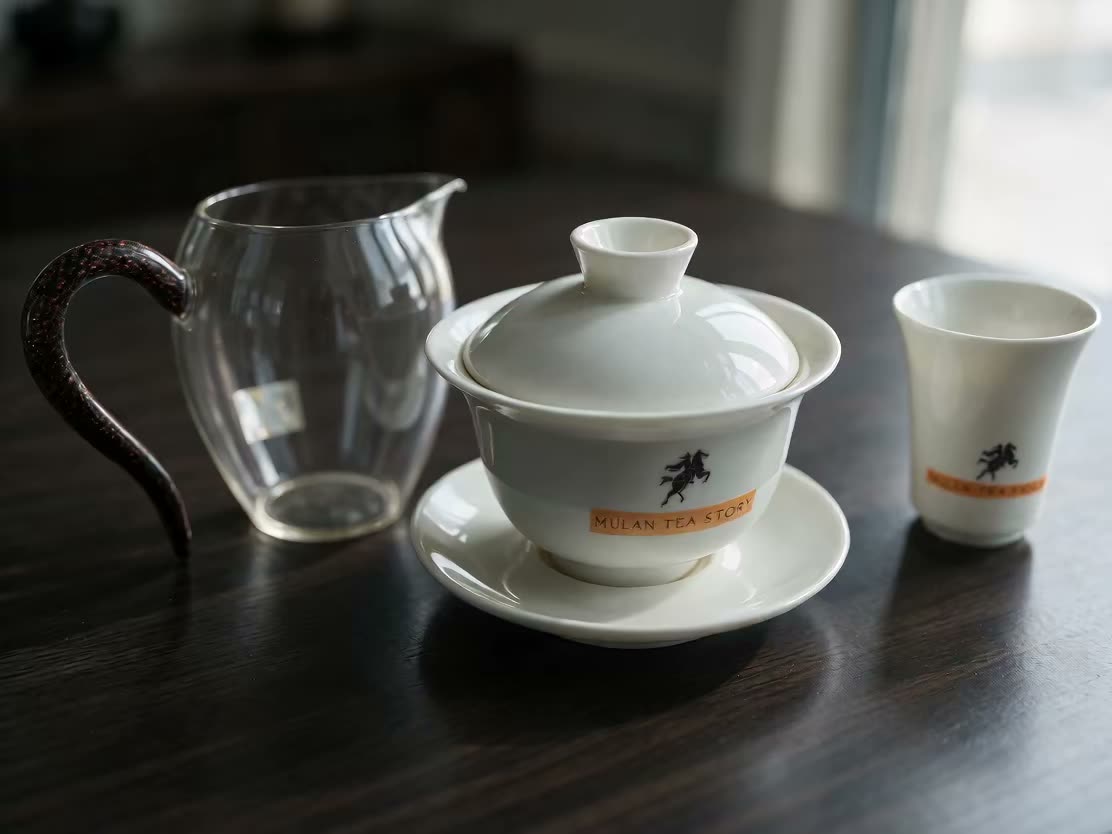
From a lump of kaolin to a whole that can brew tea, a gaiwan must pass through seven fires and waters. Most people only ever see the last gleam.
One · Why Make a Gaiwan at All
Among Chinese tea vessels, the gaiwan is the one most like a person. It has three parts, and none can be missing: the saucer is the base, the bowl is the body, the lid is the crown. Together they are one; lifted apart they are three.
More than that, it solves two problems at once. With the lid on, it holds warmth and gathers aroma; by governing the gap at the rim to pour, it filters and controls the flow. Drinking alone, you need no pot and no fairness cup — a single gaiwan is enough.
Two · The Seven Steps
- One · ThrowingKaolin takes the shape of a bowl on the wheel. Wall thickness is everything: too thick and heat travels slowly, stewing the tea; too thin and it burns the hand. As a rule the wall is 3–3.5 mm, with the rim a little thinner.
- Two · TrimmingWhile the clay is half dry it goes back on the wheel and the excess is pared away. This step decides the heft of the gaiwan — it should feel like something in the hand, but not sink it.
- Three · Bisque firingAround 800°C, firing the body to the point where it no longer dissolves in water. Only after the bisque can it be glazed.
- Four · GlazingDip-glazing or spray-glazing. The thickness of the glaze maps directly to the smoothness of the finished piece. Too thick and it runs and sticks to the base; too thin and it is rough, without light.
- Five · Glaze firingAround 1300°C, for ten-odd hours. Here the glaze melts, flows and sets — and the fate of the piece is decided.
- Six · GildingAfter the kiln, gold is painted on by hand. The thickness of the gold water and the weight of the line decide whether it breathes on the same plane as the glaze.
- Seven · RefiringA low refiring at 700–800°C binds the gold to the glaze. Fire too low and the gold flakes; too high and it dulls.
Slip at any one of the seven and everything before it is void. Which is why the yield rate of a hand-made gaiwan is never high.
The saucer is earth, the bowl the person, the lid heaven.
Closed it is one; opened it is three.
Three · Four Feels of a Good Gaiwan
- The lid rimThumb and middle finger on either side of the knob: the lid should sit steady, not wobble. A wobbling lid makes the hand shake as you pour.
- The pouring gapBetween lid rim and bowl mouth, your fingers should be able to hold a gap of about 3 mm. Too tight and nothing pours; too loose and the leaves escape.
- The bowl rimWhere the lips meet it must be round, never edged. This detail decides whether you drink, or get scalded.
- BalanceAn empty bowl on the saucer, nudged, should rock twice and stop. Rock longer and the centre of gravity sits high; full of water it will be unsteady.
None of these four feels needs expertise. Put the bowl in your hand and one use will tell you.
Four · Using It
For a 120 ml gaiwan, about 5 grams of leaf (for rock tea or oolong, 1:20–1:25). For the first pour, circle the water down the wall of the bowl; never strike the heart of the leaf directly.
To pour, hold the knob with thumb and middle finger, press the top of the knob with the index finger, and press the wrist downward — not lift and tip. This movement has not changed from the Song dynasty to today, because it saves the most effort and is the steadiest.
Five · Why Objects Make Us Quiet
Because a thing with a clear use draws a person into falling in with it without thinking. The hand goes lighter, the water goes slower, the breath goes even.
Anyone who makes gaiwans knows: the hardest part is not throwing the shape, but throwing a shape that makes a person slow their hands.
TO TASTE · A CUP FROM THE SAME SOURCE
Celadon Gaiwan
Hand-thrown, glaze-fired at 1300°C, gilded and refired after the kiln. 120 ml, a rounded rim, a pouring gap of about 3 mm. It feels like something in the hand.
Visit the Shop ↗MULAN JOURNAL, written slowly.
Volume One has 12 pieces, one every two weeks. Leave your email and the next one comes straight to you.