
MULAN JOURNAL / 01 TEA CULTURE
One Brew of Shuixian, Three Years of Fire
A roasted rock tea cannot be drunk the moment it is finished. The tea waits for the fire to recede, and the drinker waits for the tea to wake. Those two years in between are where its real taste lives.
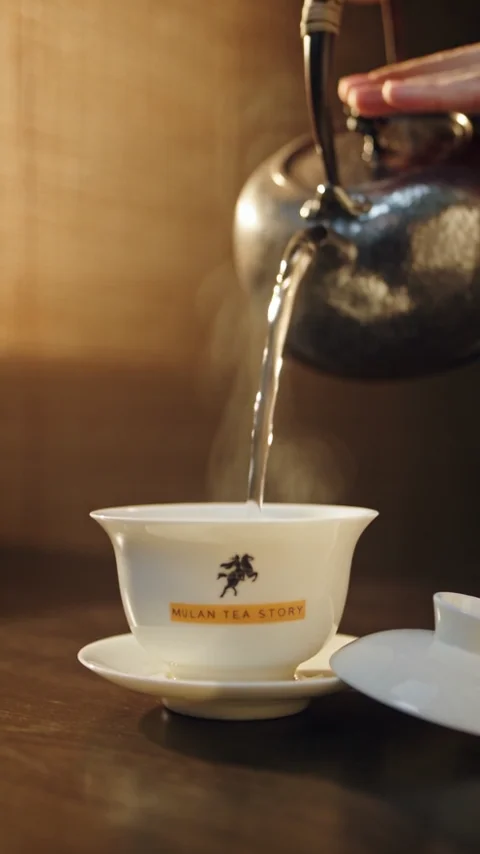
Newly roasted rock tea drinks dry. Not bitter, not astringent — a fire that pushes up from the throat. What it needs is not waking but time.
One · Roasting Is Not About Drying the Tea
Many take roasting to be a drying step. It is not. Drying ends after rolling; what roasting deals with is the part of the tea that is not yet cooked.
Rock tea is usually roasted in three passes.
- First roastHigher heat, forcing out the moisture left after rolling. This pass decides whether the tea can keep.
- Second roastThe heat comes down and the time stretches out. Sugars and amino acids undergo the Maillard reaction, and the aroma turns from green to ripe, from flighty to settled.
- Slow roastLow temperature, slow stewing — twenty or thirty hours is possible. This is the watershed: a tea stewed well keeps climbing three years later; a tea stewed past its limit dies on the spot.
The temperature in the roasting room is read with the back of the hand. The old masters put it this way: the upper body sweats, the lower body does not. A room of people around the charcoal pile; whoever's forehead dampens first tells you the fire is right.
Two · Resting the Fire: A Year and a Half of Silence
In a freshly roasted tea the fire is pressed inward. Drunk now, the aroma is buried under the fire, the body of the tea runs dry, the throat tightens. This is not a flaw; the body has not finished its walk.
- Light-fire teaResting about 1–3 months. Fine to drink in the same year; the aroma is high and lifted, but finish it soon.
- Medium-fire teaResting about 6–12 months. Aroma and body begin to balance — the daily tea for most drinkers.
- Full-fire teaResting 18 months to 3 years. This is the rock tea that is remembered: the liquor orange-red and clear, water at the entrance, bone as it goes down the throat.
So "new tea" is not a compliment among rock teas. Quite the opposite: when seasoned drinkers buy spring tea, they often ask first whether last year's is still around.
Fire is the means; receding is the end.
The tea waits for the fire to go; the drinker waits for the tea to wake.
Three · Where the Cultivar Taste of an Old Bush Comes From
Shuixian is the rock tea that needs the least explaining. It does not win by aroma; it wins by the thickness in the body and by something called cultivar taste.
- Tree ageAn old bush usually means thirty years or more, and past fifty it shows more clearly. The older the tree, the deeper the roots, the more different the mineral mix drawn up.
- Three descriptionsWood, moss and brown rice. The three usually appear together, in different proportions.
- The mountainAmong old bushes, the gap between true rock and half rock is far wider than any gap between cultivars. Rock rhythm comes from the soil left behind by weathered Danxia conglomerate; no craft can add it back.
The cultivar taste is not loud. It hides in the middle of the third and fourth pours, something that gives the liquor a sudden weight. First-timers often fall quiet for a moment, because no adjective fits.
Four · How to Judge the Age of a Shuixian
No need to read the packaging. Watch three things.
- Dry leafIn a tea whose full fire has receded all the way, the colour is dark brown with a bloom; take a handful and the sound is crisp, not dull.
- LiquorNew tea leans yellow and bright; old tea is orange-red and darker, oily and clinging to the cup. There should be no suspended matter in it.
- After the seventh pourThe crucial step. New tea gives up by the fifth; a fully rested old tea still has a middle at the seventh. The foundation of a rock tea is read in its last water.
For brewing, do not use water that is too soft. Hard water suppresses the aroma, and purified water can seem thin. Mineral water with a moderate mineral content (TDS 50–120) suits best. Boiling water, 100°C, no argument.
Five · Not Many Things Are Worth Waiting For; Tea Is One
Three years — not long, not short. A case of full-fire Shuixian rests quietly in the warehouse, and each year its taste moves a little deeper. No one can hurry it.
This is perhaps the oldest value of tea: it refuses to be consumed ahead of its time.
TO TASTE · A CUP FROM THE SAME SOURCE
Luxiu Old-Bush Shuixian
Full fire, stewed to the end, rested more than two years. The liquor is orange-red and clear — water at the entrance, bone as it goes down. From the third pour, the cultivar taste rises from the middle of the cup.
Visit the Shop ↗MULAN JOURNAL, written slowly.
Volume One has 12 pieces, one every two weeks. Leave your email and the next one comes straight to you.