
MULAN JOURNAL / 04 TRAVEL
Nine Bends of Wuyi: A Tea Map Written by a Stream
Thirty-six peaks, one Nine-Bend Stream. Rock tea's 'rock bone, floral aroma' is, at bottom, a question of geology.
If you have only met rock tea in tea houses, you will think the difference is in the craft. Come to the Wuyi Mountains and you will find the difference is the mountain.
1. First the Rock, Then the Tea
The mountains of Wuyi are Cretaceous Danxia conglomerate. The rock's character is plain: heavy with volcanic material and minerals; the soil it weathers into is slightly acidic, rich in potassium and manganese, and drains exceptionally well.
Tea raised in this soil carries minerals unlike anywhere else. That is the physical origin of rock rhyme — not an adjective, an ingredient list.
- ConglomerateWeathers coarse; water runs through fast. Roots never waterlog, but the tree must send them deep to find moisture.
- MineralsHigh potassium and manganese act directly on the ratio of polyphenols to amino acids.
- MicroclimatePeaks and cliffs block the noon sun; the mist lasts. Grown in diffuse light, the leaf keeps more amino acids.
2. Three Pits, Two Streams: The Core of the Core
Rock tea country has a boundary everyone repeats and few can draw: zhengyan, the core rock. At its center sit the Three Pits and Two Streams.
- Huiyuan PitThe largest, the longest. Its old-bush Shui Xian is held to be the most representative.
- NiulankengNarrow, deep, little sun, high humidity. Output is tiny; it is the heart of Rougui country, and a piece of ground whose price never comes down.
- DaoshuikengSpecial winds inside the pit and wide day-night swings. The liquor grips clearly, then sweetens fast.
- Liuxiang StreamBranching waterways; moss over the stone walls. The mossy note in old-bush tea is most typical here.
- Wuyuan StreamThe quietest of the five. Little is made, and much of that the factories keep for themselves.
What the five share: rock walls on all four sides, short sun, heavy vapor, and soil weathered in place from conglomerate debris, never carted in. Rock bone is what this soil leaves in the liquor after the tree has taken it up.
Same old bush — the gap between zhengyan and half rock
is far wider than the gap between varieties.
3. Half Rock, Zhou Cha: Not Better or Worse, Only Clear
- ZhengyanConglomerate soil inside the core scenic area. Thick body, unmistakable rock rhyme; at the seventh steep the middle still holds.
- Ban yanAround the scenic area, conglomerate mixed with red earth. The aroma can be very good, but body and staying power fall off clearly.
- Zhou chaTea on the stream's alluvial flats, sandy loam. Big leaves, high yield, even flavor — good everyday tea.
None of the three is 'not for drinking'. There is only one real problem: selling zhou cha as zhengyan. Knowing what is in your cup matters far more than chasing a name.
4. Two Days in Wuyishan: How to Spend Them
- Day one, morningRaft the Nine Bends. From the water, with the peaks and cliffs on both banks, you understand for the first time how a 'pit' and a 'stream' were formed.
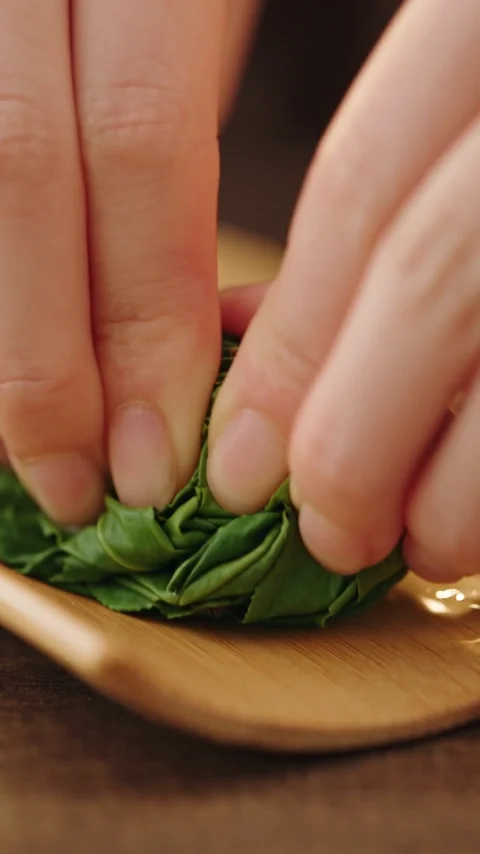
- Day one, afternoonWalk into Tianxin village and watch one round of zuoqing. Shaking and resting in alternation — the heart of how rock tea builds its aroma.
- Day two, morningWalk Niulankeng or Huiyuan. Watch the moss on the stone walls, the grains of the soil, and the age plaques on the tea trees.
- Day two, afternoonSit down at a tea factory and drink seven steeps. Be sure you reach the tail water — everything a rock tea stands on is there.
Do not rush. Wuyishan has no shortage of time; the hard part is slowing yourself down.
5. Back Home: How to Taste More Clearly
Buy three teas of one cultivar from three different plots, brew them side by side — same water, same vessel, same clock. What separates the three is what the plane ticket taught you.
More reliable than any adjective.
TO TASTE · A CUP OF THE SAME ORIGIN
Wuyi Zhengyan Rougui
A zhengyan plot, fired medium-full, rested one year. First steep high and aromatic; by the fourth the body turns thick; the tail water of the seventh runs sweet.
See it in the shop ↗MULAN JOURNAL, written slowly.
Twelve pieces in Series One, one letter every two weeks. Leave your email and the next piece comes straight to you.